Best High-Impact Architectural Statement Houseplants for Bright Rooms
Big floor trees look amazing on day one, then drop half their leaves if you park them in a dark corner. Here's how to pick a statement plant that actually fits your room.

Your ceiling height and real window light decide how an indoor tree turns out way more than a styled living-room photo ever will. One great floor plant anchors a room better than ten tiny pots crowded on a windowsill, as long as your light, ceiling room, and pets actually match the plant you bring home. Checking real light needs and pot drainage across four classic statement trees keeps big-leaf splurges looking sharp for years.
How Much Window Light Do Fiddle-Leaf Figs and Bird of Paradise Actually Need?
Big sun-loving floor trees like Ficus lyrata (500 to 1,000+ foot-candles, or 100 to 200+ PPFD) and Strelitzia nicolai (600 to 1,200+ foot-candles, or 120 to 250+ PPFD) need 10 to 14 hours of strong daily light. Parking either tree in a dim corner shrinks its roots and leaves weak, droopy stems.
Giving Big Floor Pots Real Light and Breathing Room
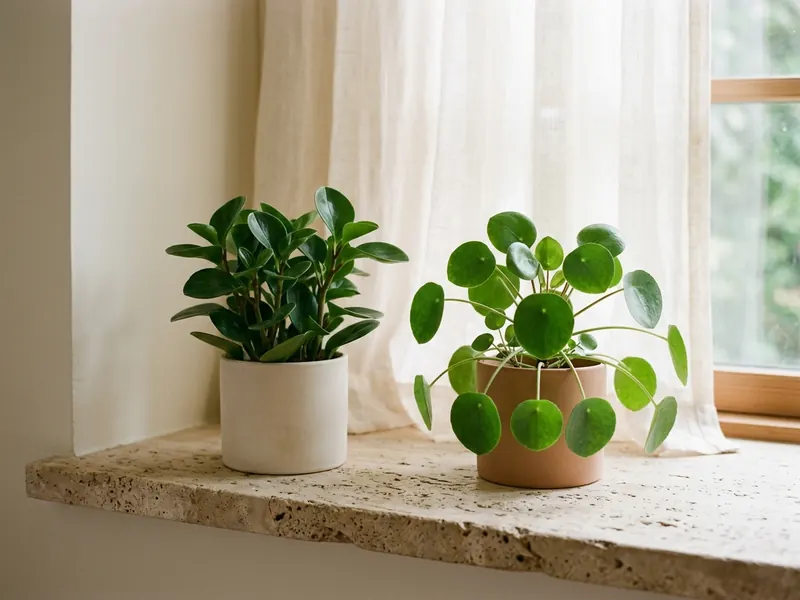
Keep Ficus lyrata and Strelitzia nicolai right near bright 500 to 1,200+ FC windows instead of dark corners.
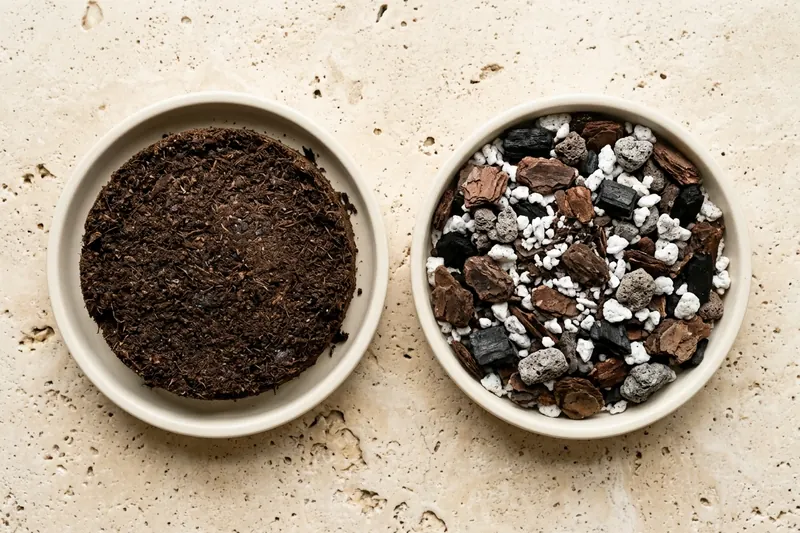
Big floor pots dry slowly, so mix chunky bark and perlite all the way through instead of dumping rocks in the bottom.
Give Strelitzia nicolai (White Bird of Paradise) 6 to 10 ft of vertical ceiling room right by a bright window, and water once the top 2 in. of airy mix dries out during spring and summer growth. Park Ficus lyrata (Fiddle-Leaf Fig, 5 to 10 ft tall indoors) right next to clear glass, let the top 2 to 3 in. of soil dry between waterings, and never leave the pot sitting in a puddle of saucer water.
Why Are Rubber Trees and Monsteras Easier Floor Plants for Most Homes?
Ficus elastica (300 to 800+ foot-candles, or 60 to 160+ PPFD) and Monstera deliciosa (250 to 700 foot-candles, or 50 to 140 PPFD) still grow into bold 4 to 8 ft statement plants in moderately bright window spots where sun-hungrier trees struggle. Both still need chunky, fast-draining potting mix so trapped bottom water doesn't push air space below 10 percent.
Ficus elastica (Rubber Tree) holds thick, glossy leaves on sturdy upright trunks when you let the top 2 to 3 in. dry out first. Monstera deliciosa spreads 3 to 5 ft wide unless you tie it up a moss pole or stake in a chunky mix blended with 20 to 30 percent perlite or bark, and you should keep it strictly potted indoors if you live in a frost-free tropical area. Using a taller floor pot alongside that chunky mix also keeps a deeper airy root zone above any wet soil down at the bottom.
Which Tall Statement Plants Are Safe Around Cats and Dogs?
All four of those classic statement plants carry ASPCA pet-toxicity warnings: Ficus elastica and Ficus lyrata have irritating ficin and psoralen sap, Monstera deliciosa carries insoluble calcium oxalate crystals that cause mouth pain, drooling, and vomiting, and Strelitzia nicolai causes mild stomach upset and drowsiness. If your cat or dog likes to chew leaves at floor level, skip those four and grab an ASPCA non-toxic tree instead.
Two great ASPCA non-toxic floor plants give you real height without the worry: Beaucarnea recurvata (Ponytail Palm, 3 to 5 ft tall with a thick water-storing trunk base that loves 400 to 1,000 FC and drying 80 to 90 percent between waterings) and Pachira aquatica (Money Tree, 3 to 6 ft tall with hand-shaped palmate leaves at 250 to 600 FC when the top 50 to 60 percent dries).
How Can You Add Wall Plants Above a Floor Tree Without Hanging Cords?
Putting a tall tree near your brightest window and mounting smaller plants on the wall beside it balances out the room while keeping trailing leaves safely above curious pets. Built-in wall grow lights also fill in the light gap as soon as you step away from the window.
When you want clean wall framing without wires running down the drywall, The Wallflower With Battery Pack ($75 USD with battery included, or $62 USD BYOB using 3.7V rechargeable lithium-ion cells with integrated PCM protection) packs a hidden rechargeable battery compartment, integrated BMS protection, a moisture barrier isolated from the reservoir, and a full-spectrum LED Light Halo. Physical on-hand shelf stock is currently at zero, so check live made-to-order availability or join our waitlist for restock updates.
References
- Chen, J., McConnell, D. B., Henny, R. J., & Norman, D. J. (2020). Cultural Guidelines for Commercial Production and Interior Acclimatization of Tropical Foliage Plants. University of Florida IFAS Extension (UF/IFAS), Bulletin ENH957 / CIR480. EXT_ID:UF-IFAS-ENH957
- Poorter, H., Niinemets, U., Ntagkas, N., Siebenkas, A., Maenpaa, M., Matsubara, S., & Pons, T. L. (2019). A meta-analysis of plant responses to light intensity for 70 traits ranging from molecules to whole plant performance. New Phytologist, Vol. 223, Issue 3, pp. 1073-1105. DOI:10.1111/nph.15754
- Passioura, J. B. (2006). The perils of pot experiments. Functional Plant Biology, Vol. 33, Issue 12, pp. 1075-1079. DOI:10.1071/FP06223
- Ferrarezi, R. S., Weaver, G. M., van Iersel, M. W., & Testezlaf, R. (2015). Subirrigation: Historical overview, challenges, and future prospects. HortTechnology, Vol. 25, Issue 3, pp. 262-276. DOI:10.21273/HORTTECH.25.3.262
- ASPCA Animal Poison Control Center (2024). Toxic and Non-Toxic Plants Database: Araceae, Moraceae, Asparagaceae, Begoniaceae, Polypodiaceae, Apocynaceae, and Marantaceae. American Society for the Prevention of Cruelty to Animals (ASPCA) Veterinary Toxicology Registry. ASPCA_ID:ASPCA-APCC-PLANTS-2024
- University of Florida IFAS Assessment of Non-Native Plants (2023). Indoor Containment and Responsible Disposal of Tropical Vines (Epipremnum pinnatum / aureum & Syngonium) in Frost-Free Zones. UF/IFAS Center for Aquatic and Invasive Plants Assessment. EXT_ID:UF-IFAS-INVASIVE-EPI

