Why Do Houseplant Leaf Tips Turn Crispy and Brown?
Why leaving tap water out overnight won't stop brown leaf tips on calatheas, spider plants, or dracaenas, and how to tell dry air apart from tap-water burn.

Trimming brown leaf tips off with kitchen scissors makes a plant look tidy on Monday, right up until fresh brown edges creep back because nothing changed in your watering pitcher. When Goeppertia orbifolia, Chlorophytum comosum, or Dracaena trifasciata gets crispy dead tips indoors, a lot of folks figure leaving tap water out on the counter overnight fixes it. Knowing what actually gases off from an open pitcher and what stays dissolved in the water is how you stop tip burn for good.
Does Leaving Tap Water Out Overnight Remove Fluoride and Chloramines?
Leaving tap water out on the counter for 24 hours lets regular free chlorine gas off, but it doesn't remove chloramines or fluoride at all. Those leftover minerals and old fertilizer salts ride water straight out to the leaf tips, burning crispy brown edges onto sensitive plants like Goeppertia, Dracaena, and Chlorophytum.
Spotting Dry-Room Edges Versus Fluoride and Salt Burn
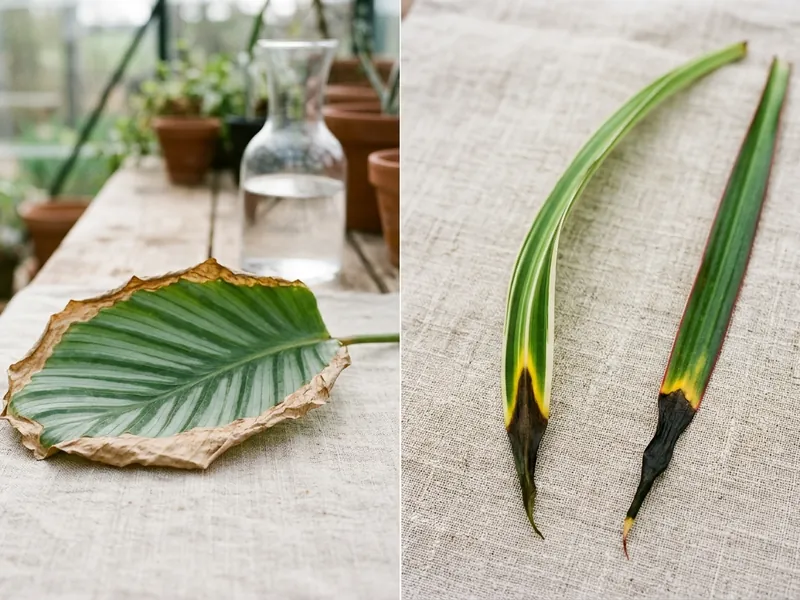
Sitting tap water out for 24 hours only vents chlorine. Switch sensitive plants to filtered or rain water and flush old salts out.
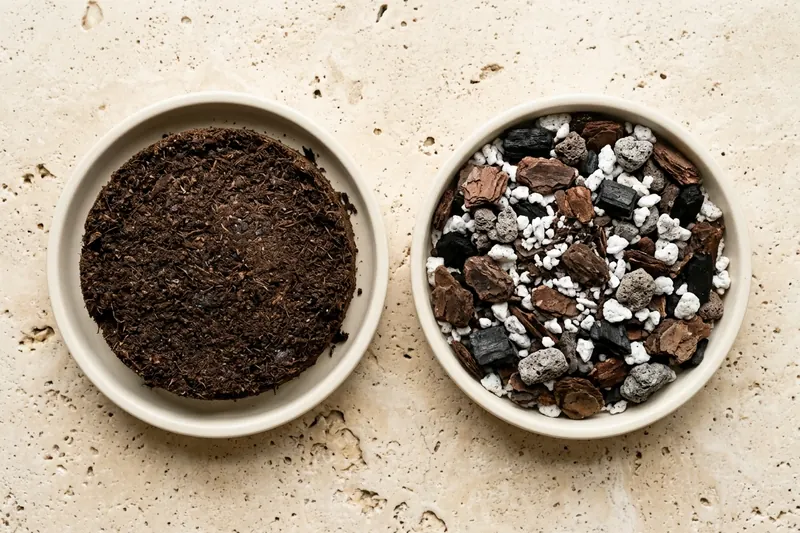
Rinse a fast-draining 20% to 30% perlite or bark mix in the sink occasionally, and pause fertilizer when winter growth slows down.
Because chloramines and fluoride stay dissolved in an open pitcher, watering sensitive plants from yesterday's tap water still dumps those minerals right into the pot. Goeppertia orbifolia (150 to 350 foot-candles, or 30 to 70 PPFD, growing 2 to 3 ft wide indoors) wants filtered or low-fluoride water whenever the top 1 inch of potting mix dries out. Chlorophytum comosum (150 to 500 FC, or 30 to 100 PPFD, reaching 12 to 24 in. with baby plantlets) is touchy about city fluoride too and does best when you let the top 50 percent of its mix dry first.
How Do Chunky Potting Mix and Smart Watering Protect Leaf Edges?
After a pot finishes draining, fine store-bought soil hangs onto a soggy layer of water at the bottom where air space drops below 10 percent and roots start suffocating. Mixing 20 to 30 percent coarse perlite, pumice, or orchid bark into your potting soil gives roots plenty of air while you match each plant's natural dry-down rhythm.
Instead of watering every pot on the same day of the week, just check how deep the soil has dried. Water Goeppertia orbifolia with filtered or low-fluoride water once the top 1 inch feels dry, let Chlorophytum comosum dry halfway down the pot, and let Dracaena trifasciata (75 to 600 FC, or 15 to 120 PPFD, reaching 1.5 to 3.5 ft tall indoors) dry 90 to 100 percent between waterings.
When Should You Flush Old Salts Out and Skip Winter Fertilizer?
Hold off on fertilizer or cut way back during the dim winter months when indoor growth slows down, otherwise leftover fertilizer salts build up in the pot and burn leaf edges. Heavy unamended peat packs down over time and traps excess moisture and salts, while a chunky mix with 20 to 30 percent perlite, pumice, or bark makes it easy to rinse the pot out when needed.
Running clean, low-fluoride water slowly through the top of a chunky mix in the sink flushes built-up salts out the bottom holes without leaving the roots waterlogged afterward. Once you switch sensitive plants like Goeppertia, Chlorophytum, and Dracaena to filtered water and pause winter feeding, new leaves come in clean without burnt tips.
Which Tip-Burn-Prone Plants Are Safe Around Cats and Dogs?
According to the ASPCA Animal Poison Control Center database, Goeppertia orbifolia and Chlorophytum comosum are non-toxic to cats and dogs, though Chlorophytum comosum can still upset a pet's stomach if they chew a bunch of leaves. Dracaena trifasciata is a different story because its saponins cause nausea, vomiting, and drooling in cats and dogs, so keep Dracaena pots up out of pet reach.
When you want steady bottom wicking paired with a chunky 20 to 30 percent perlite or fine bark mix that's still easy to rinse in the sink, The Plant Roast's Side-Eye ($35 USD) is an asymmetrical 4-inch self-watering PLA planter 3D-printed in the USA with an internal reservoir and floating water-level indicator. Physical on-hand shelf stock is currently at zero, so check live made-to-order availability or join our waitlist for restock updates.
References
- Clemson Cooperative Extension Home & Garden Information Center (2021). Indoor Plants: Watering, Soluble Salts, Fluoride Tip Burn, and Fertilizing. Clemson University Cooperative Extension, Fact Sheet HGIC 1450 / HGIC 1459. EXT_ID:CLEMSON-HGIC-1450
- Passioura, J. B. (2006). The perils of pot experiments. Functional Plant Biology, Vol. 33, Issue 12, pp. 1075-1079. DOI:10.1071/FP06223
- Ferrarezi, R. S., Weaver, G. M., van Iersel, M. W., & Testezlaf, R. (2015). Subirrigation: Historical overview, challenges, and future prospects. HortTechnology, Vol. 25, Issue 3, pp. 262-276. DOI:10.21273/HORTTECH.25.3.262
- ASPCA Animal Poison Control Center (2024). Toxic and Non-Toxic Plants Database: Araceae, Moraceae, Asparagaceae, Begoniaceae, Polypodiaceae, Apocynaceae, and Marantaceae. American Society for the Prevention of Cruelty to Animals (ASPCA) Veterinary Toxicology Registry. ASPCA_ID:ASPCA-APCC-PLANTS-2024

