Why Lower Pothos Leaves Turn Yellow While Top Growth Looks Fine
How to tell if your pothos is just dropping an old bottom leaf or suffocating in wet soil, so you don't accidentally drown a healthy plant.

A single yellow leaf down near the dirt doesn't automatically mean you drowned your plant. When Epipremnum aureum or Philodendron hederaceum turns yellow near the pot rim, two completely opposite things could be happening inside the pot. Checking which leaves changed color and feeling a couple inches into the soil tells you right away whether your vine is just retiring an old leaf or suffocating in soggy soil.
How Do You Tell Normal Old-Leaf Drop Apart From Suffocating Roots?
If one or two of the oldest leaves down by the soil slowly turn yellow while new growth at the tips stays firm, your vine is totally fine and just pulling nutrients from old leaves before dropping them. But if leaves yellow up and down the stem at once in wet soil, your roots can't breathe and may be rotting.
Telling Normal Old-Leaf Drop Apart From Soggy Soil
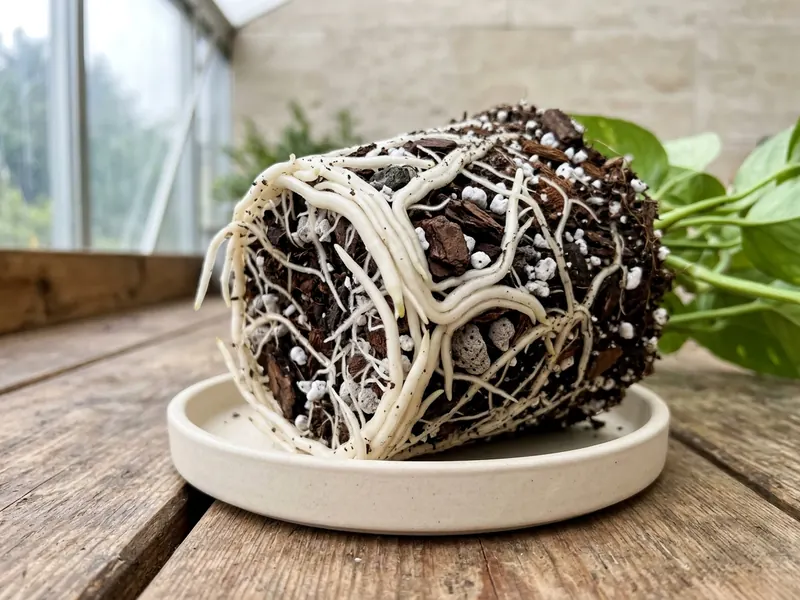
Your vine is just pulling nutrients out of shaded lower leaves while fresh growth at the tips stays firm.
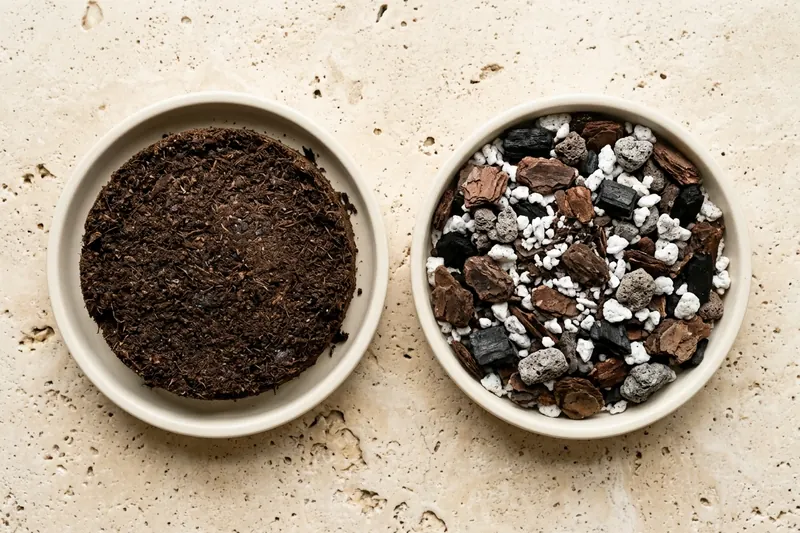
When air space drops below 10%, fine roots suffocate. Mix in 20% to 30% perlite or bark so roots can breathe.
Indoors, trailing vines like Epipremnum aureum (happy across 75 to 400 foot-candles, or 15 to 80 PPFD, reaching 4 to 10 ft indoors) and Philodendron hederaceum (100 to 400 foot-candles, or 20 to 80 PPFD, reaching 4 to 8 ft) naturally let go of shaded older leaves near the rim. Your vine pulls reusable nitrogen out of that oldest leaf stem to feed fresh growth out at the tip. As long as new leaves unfurl firm and glossy while only 1 to 2 bottom leaves fade, let that yellow leaf come off on its own and stick to your normal watering routine.
What Happens Inside a Pot When Wet Soil Suffocates Roots?
Even after a pot stops dripping, fine potting soil holds a soggy layer of trapped water at the bottom, often called a perched water table, where air space drops below 10 percent and blocks oxygen from reaching the roots. When dense peat stays waterlogged like that, fine roots suffocate and can't pump water or nutrients up the vine.
Because suffocating roots can't move water anymore, middle and upper leaves start yellowing across several nodes at once even though the bottom of the pot is still wet. Pouring more water onto a soggy pot just makes the oxygen problem worse. Instead, wait until the top 50 percent of an airy potting mix dries out before watering Epipremnum aureum or Philodendron hederaceum, and check moisture down inside the pot with your finger instead of trusting how dry the top looks.
How Do You Get Air Back to Your Roots Without Hurting Healthy Vines?
Swapping heavy store-bought peat for a chunkier potting mix blended with 20 to 30 percent perlite, pumice, or orchid bark opens up real breathing room around your roots. Using a slightly taller pot alongside that chunky mix also leaves a deeper zone of airy soil above the wet layer at the bottom.
If a vine is yellowing up and down the stem in wet soil, slide it out of the pot, snip off any mushy brown roots, and repot into a fast-draining mix so healthy roots can breathe again. Never dump a layer of gravel or pebbles in the bottom of a pot under finer soil, because bottom rocks don't help drainage and actually push the 100 percent soaked zone higher up into the root ball.
What Pet-Safety and Disposal Rules Should You Know for Pothos and Philodendrons?
According to ASPCA toxicology records, both Epipremnum aureum and Philodendron hederaceum carry insoluble calcium oxalate crystals that cause mouth irritation, pawing at the face, drooling, and vomiting in cats and dogs. And if you live in frost-free USDA Zones 10 to 12 like South Florida or Hawaii, Epipremnum aureum can root outdoors and smother native tree canopies.
Keep trailing vines up on high shelves out of reach of curious cats and dogs, and if you live in a frost-free climate, root healthy trimmings indoors or seal scraps inside household trash bags instead of tossing them on an outdoor compost pile. If you want a 4 in. self-watering PLA planter built to work with a chunky 20 to 30 percent perlite or fine bark mix, The Plant Roast's Side-Eye ($35 USD) has an internal reservoir and floating water-level indicator. Physical on-hand shelf stock is currently at zero, so check live made-to-order availability on the product page or hop on our restock waitlist.
References
- Passioura, J. B. (2006). The perils of pot experiments. Functional Plant Biology, Vol. 33, Issue 12, pp. 1075-1079. DOI:10.1071/FP06223
- Henny, R. J., Chen, J., & Mellich, T. A. (2018). Epipremnum aureum Cultural Guidelines and Physiological Disorders in Interiorscapes. University of Florida IFAS Extension (UF/IFAS), Publication ENH1254. EXT_ID:UF-IFAS-ENH1254
- Chalker-Scott, L. (2019). The Myth of Drainage Material in Container Plantings. Washington State University Cooperative Extension Horticultural Myths Series. EXT_ID:WSU-EXT-DRAINAGE-01
- Ferrarezi, R. S., Weaver, G. M., van Iersel, M. W., & Testezlaf, R. (2015). Subirrigation: Historical overview, challenges, and future prospects. HortTechnology, Vol. 25, Issue 3, pp. 262-276. DOI:10.21273/HORTTECH.25.3.262
- ASPCA Animal Poison Control Center (2024). Toxic and Non-Toxic Plants Database: Araceae, Moraceae, Asparagaceae, Begoniaceae, Polypodiaceae, Apocynaceae, and Marantaceae. American Society for the Prevention of Cruelty to Animals (ASPCA) Veterinary Toxicology Registry. ASPCA_ID:ASPCA-APCC-PLANTS-2024
- University of Florida IFAS Assessment of Non-Native Plants (2023). Indoor Containment and Responsible Disposal of Tropical Vines (Epipremnum pinnatum / aureum & Syngonium) in Frost-Free Zones. UF/IFAS Center for Aquatic and Invasive Plants Assessment. EXT_ID:UF-IFAS-INVASIVE-EPI

